Developing or upgrading a resort water park is a major capital investment. Water slides often serve as the main visual anchor and driver for booking decisions, making the choice of material critical.
When evaluating equipment suppliers, resort developers and procurement managers often compare Fiber-Reinforced Plastic (FRP / Fiberglass) and Rotomolded Polyethylene (PE / Plastic). While both materials have their place in the leisure industry, choosing the wrong material for your project scope can lead to premature surface degradation, high maintenance costs, or structural limits.
This guide breaks down the core material differences, engineering capabilities, and long-term costs to help you make an informed decision.
Material Overview: What Are FRP and Rotomolded Plastic?
Fiber-Reinforced Plastic (FRP / Fiberglass)
Fiberglass water slides are constructed by layering glass fiber reinforcements inside a mold, saturated with unsaturated polyester resin, and finished with a specialized, high-grade gelcoat surface. This multi-layer composite creates a rigid, lightweight, and high-strength structure capable of supporting complex geometries and heavy passenger loads.
Rotomolded Polyethylene (PE / Plastic)
Rotomolded plastic slides are made by melting polymer resin inside a closed hollow mold while rotating it on two axes. As the liquid plastic coats the inner walls of the mold, it cools into a single, seamless hollow piece. This process is best suited for uniform, small-to-medium molded shapes.
4 Key Differences Every Resort Developer Must Know
1. Durability & Structural Integrity
- FRP: Offers high tensile strength and structural rigidity. Fiberglass flumes maintain their shape across vast spans without sagging, allowing for high-drop towers, massive funnels, and complex twisting trajectories.
- Plastic: PE plastic is more flexible and impact-resistant against minor bumps, but it lacks structural rigidity over long distances. Under high thermal expansion or heavy loads, long plastic flumes can warp or require dense supporting steel frameworks.
2. UV Resistance & Weatherability
- FRP: Coated with Premium Isophthalic NPG Gelcoat, fiberglass slides withstand prolonged exposure to intense sunlight, high humidity, and salty coastal air. Gelcoats shield the underlying composite from UV degradation, preserving vibrant colors for years.
- Plastic: PE plastic relies on UV stabilizers blended directly into the raw resin. In tropical or desert resort environments with high UV indices, plastic tends to fade, chalk, or become brittle faster over time.
3. Ride Experience & Load Capacity
- FRP: Precision flange manufacturing allows fiberglass flumes to be bolted together with micro-level seamless joints. This eliminates friction bumps, enabling smooth, high-speed rides and accommodating multi-person rafts or high-capacity tube rides.
- Plastic: Plastic expands and contracts significantly with ambient temperature changes. This movement can lead to slight lip misalignments at section joints, restricting plastic slides mostly to body slides or smaller child-focused rides without rafts.
4. Long-Term Maintenance & Lifecycle Cost
- FRP: Higher initial capital investment, but offers an operational lifespan of 15 to 20+ years. If scratches or dulling occur, the gelcoat surface can be repaired, buffed, polished, or recoated on-site without replacing the entire slide segment.
- Plastic: Lower initial purchase price, but has a shorter commercial lifespan (typically 5 to 8 years under heavy use). Repairing cracked or sun-damaged PE plastic is difficult, often requiring full segment replacements.
Comparison Summary: FRP vs. Plastic at a Glance
| Feature / Metric | Fiberglass (FRP) Water Slides | Rotomolded Plastic (PE) Slides |
| Primary Application | Commercial water parks, resorts, iconic attractions | Hotel splash pads, toddler zones, small pools |
| Scale & Customization | Unlimited (Custom heights, big bowls, tornadoes) | Limited by mold sizes (Small-to-medium slides) |
| Flume Joint Smoothness | High precision (Micro-level alignment) | Moderate (Thermal expansion causes joint shifts) |
| UV & Weather Resistance | Superior (Marine-grade gelcoat protection) | Moderate (Dependent on resin UV additives) |
| Expected Lifespan | 15 – 20+ Years | 5 – 8 Years |
| Repairability | Excellent (On-site gelcoat touch-up and repolishing) | Poor (Cracks usually require full replacement) |
Decision Matrix: Which Is Best for Your Resort?
Choose Fiberglass (FRP) If:
- You are building a commercial resort, water park, or destination hotel aiming for high daily guest capacity.
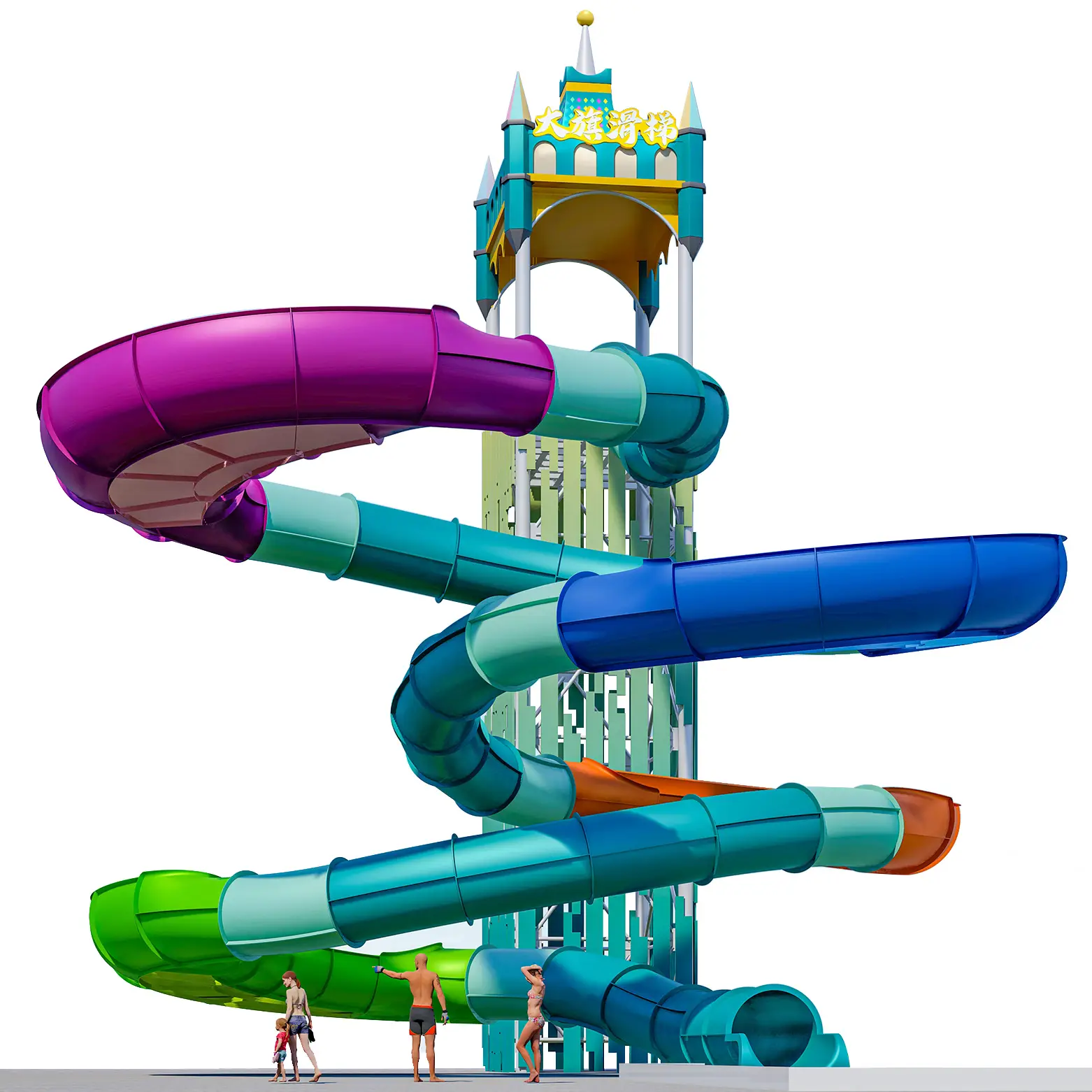
- You need custom-designed signature rides (e.g., giant bowl slides, multi-lane family raft rides).
- Your project is located in an area with high UV exposure, high temperatures, or coastal salt air.
- You are looking for a long-term asset with low lifecycle costs over a 15+ year operational horizon.
Choose Rotomolded Plastic If:
- You are adding a basic splash pad or small play area exclusively for toddlers under 6 years old.
- You have a strict short-term budget and need simple, standardized, off-the-shelf slide components.
- The equipment is intended for low-frequency or temporary seasonal use.
Conclusion & Engineering Support
While plastic slides offer a quick, low-cost solution for small children’s play areas, Fiberglass (FRP) remains the industry standard for commercial resort water parks. FRP delivers the safety, structural strength, weather resistance, and visual appeal required to drive resort bookings and generate a strong return on investment over decades.
Planning a resort water park or upgrading your attraction mix? Contact our engineering team to request a custom CAD layout, technical specs, and factory-direct pricing for your project.