For investors and operators of indoor water parks and hotel aquatic play centers, one of the most underestimated hidden costs comes from uncontrolled indoor microclimate. Many projects start suffering from stifling air, pungent chlorine smell, moldy walls, and condensation on water slides within just 6 to 12 months of opening. Guest complaints about “overwhelming chemical fumes” and “stuffy, hard-to-breathe air” directly drag down repeat visit rates and drive up maintenance and renovation costs.
Most people blame “poor ventilation”, but the root cause is a systematic flaw in indoor water park ventilation design. Conventional commercial ventilation logic simply cannot match the unique microclimate of water parks: high humidity, high chlorine levels, and extreme thermal loads. 90% of design teams still apply standard HVAC specifications to water park projects, leaving inherent defects that are extremely costly to fix later.
Why Traditional Ventilation Fails in Indoor Water Parks
Indoor water parks are far more environmentally complex than shopping malls or standard swimming pools. The core conflict lies in the combined effect of continuous water evaporation and disinfection by-products, which conventional ventilation systems are not built to handle.
1. Non-Linear Thermal and Humidity Loads from Evaporation
With large open water surfaces, flowing water slides, and interactive spray features, indoor water parks generate constant, heavy evaporation. Thermal and humidity loads rise non-linearly with guest count, water temperature, and air temperature. Conventional air conditioners rely on cooling-based dehumidification, which loses efficiency rapidly under sustained high moisture loads, leading to unstable room temperatures and surging energy use.
2. Chloramines: The Invisible Pollutant Sinking to Breathing Level
Chloramines (primarily trichloramine), the by-product of pool water disinfection, are denser than air. They naturally sink to a zone 1.2–1.5 meters above the water surface — exactly the breathing level of standing and walking guests. This is why the chlorine smell hits hardest when you first enter a park, and becomes stronger closer to the water. Traditional top-supply, top-return ventilation patterns cannot effectively extract chloramines trapped at the lower level; they only circulate cleaner air in the upper part of the space.
3. Standard Commercial HVAC vs. Professional Water Park Air Control: Key Differences
Many projects install standard commercial central air conditioning, which may seem to meet cooling and air exchange requirements, but is fundamentally mismatched to water park conditions.
| Comparison Dimension | Standard Commercial HVAC | Professional Indoor Water Park Air Control System |
|---|---|---|
| Core Design Goal | Temperature regulation + general air exchange | Precision humidity control + targeted exhaust of harmful gases + temperature balance |
| Airflow Logic | Top supply / top return, uniform whole-space ventilation | Stratified airflow: low-level exhaust, high-level supply, zoned pressure control |
| Dehumidification Method | Cooling-based only, limited capacity | Combined cooling + desiccant / solution dehumidification for sustained high humidity |
| Corrosion Resistance | Standard metal ductwork, no special protection | Corrosion-resistant ducts and components for high-chlorine, high-humidity environments |
| Typical Applications | Malls, office buildings, standard venues | Indoor water parks, heated swimming pools, spa and wellness centers |
4 Overlooked Ventilation & Airflow Details That Ruin Water Park Air Quality
The performance of a water park’s environmental control system is often determined by the easiest-to-miss details. The four design blind spots below are the root cause of odor, mold, and condensation issues in most projects.
1. Negative Pressure Imbalance: Chloramine Buildup in “Dead Air Zones”
Design Blind Spot: Many designs only calculate overall air changes per hour based on total volume, ignoring pressure balance in slide towers, slide turnaround areas, equipment corners, and pool edges. These areas easily become “dead air zones” with almost no circulation. Chloramines and moisture accumulate here over time and slowly diffuse into the rest of the space.
Solution: Adopt a multi-layered three-dimensional airflow design with a “targeted low-level exhaust + high-precision high-level supply” structure. Set separate pressure gradients for different functional zones (slide areas, play zones, rest areas), and add supply and exhaust points at low-level dead spots prone to exhaust buildup. Use CFD simulation to verify airflow patterns in advance and eliminate ventilation blind spots.
2. Misplaced Return Air Vents: High-Level Returns Only Pull Clean Air
Design Blind Spot: Most projects install return air vents at standard ceiling height (2.8 meters and above). Due to the higher density of warm, moist air and the sinking nature of chloramines, the air in the upper part of the space is actually relatively clean and diluted. The most polluted, high-humidity, high-chloramine air stays at mid-to-low levels. High-level returns essentially “extract clean air and leave exhaust behind”, drastically reducing ventilation efficiency.
Solution: Lower main return/exhaust vents to a specific height near the water surface and main walkways (usually 0.8–1.2 meters above water level) to target the most polluted lower-level air. At the same time, supply dehumidified, filtered fresh air from high overhead, creating top-down displacement ventilation that greatly improves chloramine removal efficiency.
3. Thermal Bridging at Equipment Penetrations: Condensation and Mold Growth
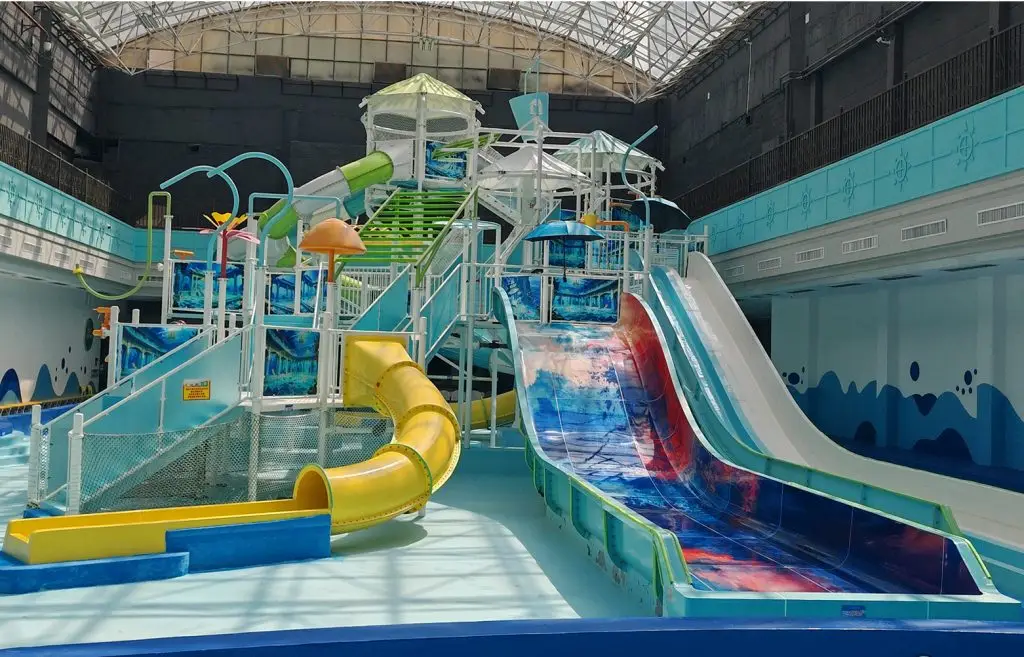
Design Blind Spot: Large fiberglass water slides, interactive water play structures and other equipment often penetrate walls or extend partially outdoors. The junction between equipment and building walls easily forms a thermal bridge. When indoor-outdoor temperature differences are large in winter, the cold bridge surface drops below the dew point, causing continuous condensation in the gaps. This leads to mold on surrounding walls, corrosion of metal fasteners, and even water damage to the building structure.
Solution: Install airtight polymer flexible connections to block thermal bridges, and add a local independent micro-circulation temperature control system at wall penetration points to keep junction temperatures above the dew point. In DAQI’s global indoor water park projects, all custom large-scale water slides include pre-construction condensation risk assessments for wall penetrations, with integrated node design coordinated with the HVAC team to prevent mold issues from the start.
4. Material Incompatibility: Standard Ducts Corrode in 1–2 Years, Causing Secondary Pollution
Design Blind Spot: Many projects use standard galvanized steel ductwork. In the high-humidity, high-chlorine environment of a water park, the inner surface of ducts can corrode, perforate, and shed rust scale within 1–2 years. This not only causes air leakage and higher energy costs, but also sends rust particles into the space through supply air, creating secondary air pollution, shortening duct life, and increasing replacement costs.
Solution: Select corrosion-resistant duct materials for full lifecycle performance, such as PVC composite ducts, fiberglass ducts, or coated metal ducts. Also consider surface compatibility between ventilation systems and amusement equipment. For example, high-quality fiberglass water slides made with L-RTM technology have a dense, smooth surface that resists algae and bacteria growth. Combined with self-cleaning surface designs, they reduce local odor and mold growth and work synergistically with the air control system.
DAQI Turnkey Solution: Closed-Loop Air Control from CFD Simulation to On-Site Delivery
As a leading custom water park equipment manufacturer and turnkey solution provider with project experience in 50+ countries, DAQI delivers full-chain environmental control support for indoor water parks — from early planning to long-term operation.
- Pre-Construction CFD Simulation: During project planning, we use computational fluid dynamics to simulate airflow patterns, temperature fields, humidity fields, and chloramine concentration distribution throughout the space. We identify dead zones, condensation points, and pressure imbalances early, and optimize supply/exhaust vent layout and parameters to eliminate over 90% of common HVAC issues at the design stage.
- Integrated Equipment & HVAC Design: We coordinate the layout of water slides, wave systems and other attractions with the ventilation and dehumidification system design. Special nodes such as large equipment wall penetrations and slide tower interiors receive pre-engineered condensation and corrosion treatment, avoiding the high cost of post-construction retrofits.
- Full-Process Technical Support: We provide complete HVAC technical documentation, installation guidance, and operator training. Backed by our 30,000㎡ modern production base and Special Equipment Production License, we ensure reliable solution delivery and long-term operational performance.
If you are planning an indoor water park project, or if your existing facility is struggling with humidity, odor, or mold issues, visit the official DAQI website for a free project evaluation and customized technical solution.
Frequently Asked Questions (FAQ)
Q1: How do you permanently eliminate chloramine odor in an indoor water park?
Chloramine odor cannot be eliminated with a single measure. It requires a combined strategy of “source water quality improvement + targeted low-level exhaust + fresh air displacement”:
- Source control: Optimize water treatment with medium-pressure UV and activated carbon to reduce chloramine formation at the source.
- Ventilation: Use targeted low-level exhaust systems to extract high-concentration chloramine directly above the water surface, preventing it from settling at breathing level.
- Dilution: Supply dehumidified, filtered fresh air from high level to create top-down displacement airflow, avoiding short-circuiting and improving overall air quality.
Q2: What humidity level should an indoor water park maintain to prevent equipment and building degradation?
Indoor water parks should maintain relative humidity within the 55%–65% engineering range:
- Under peak summer conditions, relative humidity should not exceed 70%, as higher levels accelerate mold growth, metal corrosion, and fiberglass equipment aging.
- In winter conditions, relative humidity should not drop below 50% to avoid guest discomfort and excessive evaporation-driven energy consumption. Precise humidity control extends building and equipment lifespan while significantly improving guest comfort and encouraging repeat visits.
Q3: Why do corners still smell musty even after installing an HVAC system?
Persistent musty odors in corners are almost always caused by airflow short-circuiting or ventilation blind zones. Three common causes:
- Supply and return vents are placed too close together, so fresh air is pulled into the return immediately before it can reach corner areas.
- Hidden areas such as the back of slides, equipment plenum spaces, and wall corners are not included in the airflow design, creating dead zones where moisture accumulates and mold grows.
- Thermal bridges at pipe penetrations and equipment junctions cause continuous local condensation, leading to mold growth and odors. Fixing these issues requires on-site testing combined with CFD simulation to locate blind zones, followed by targeted local exhaust additions or condensation barrier treatments.