In the early planning stages of any water park or integrated resort, land efficiency is one of the most decisive factors behind overall project profitability. Water park developers and operators often face a difficult trade-off: they need striking, high-thrill attractions to drive ticket sales, yet strict site boundaries and high land costs constrain the footprint available for massive standalone rides.
During peak season, low-capacity water park equipment creates excessively long queue lines. This lowers rider satisfaction and drastically reduces the time guests spend exploring secondary spend options such as food, beverages, and merchandise. Designed by DAQI, the Fantasy Castle Twin Vortex Bowl Slide Complex offers an engineered spatial alternative to resolve these classic water park design bottlenecks.
1. Spatial Engineering: Optimizing Land Use in Water Park Projects
1. Structural Overlap and Compact Steel Framing
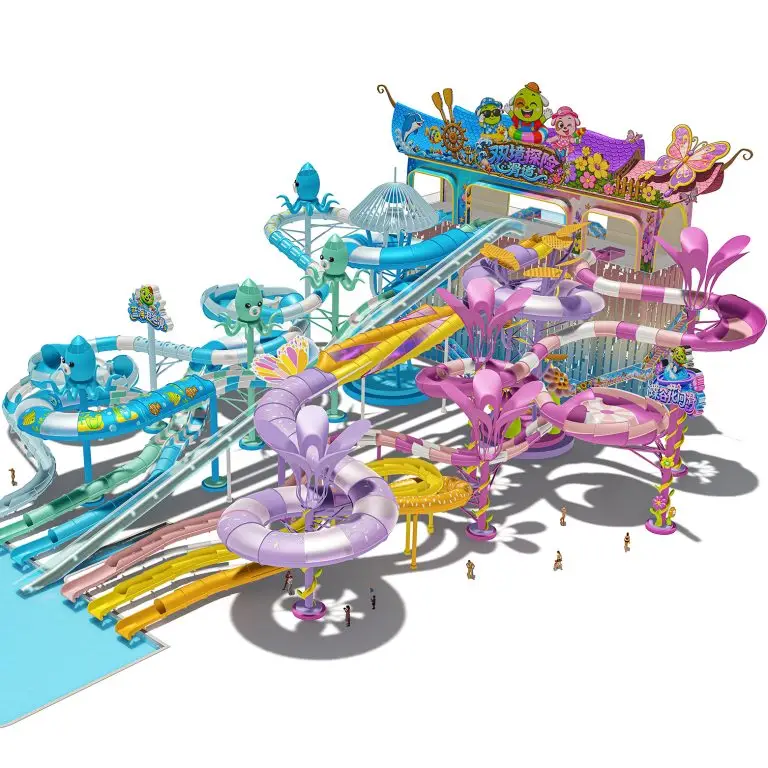
Installing two separate large-scale bowl rides in a water park typically requires individual launch towers, separate steel supporting columns, and dedicated splashdown areas—often consuming over 1,200 square meters. The Fantasy Castle system employs a streamlined modular layout:
- Consolidated Launch Tower: Integrates two independent flume entrances onto a single tower structure, reducing base construction and steel costs for the water park.
- Interwoven Trajectory Design: By overlapping flume paths and column footprints, the total ground space required is 30% to 35% less than installing two separate single-bowl rides.
2. Dual-Angle Rider Interaction
Beyond spatial savings, this compact arrangement creates dynamic visual engagement. As riders circle the bowl under strong centrifugal forces, they can spot rafts in the adjacent bowl sliding past. This unique interaction boosts rider excitement and encourages social media sharing among water park visitors.
2. Operational Metrics: Capacity and Energy Management in Water Parks
When evaluating water park slides, looking beyond the initial equipment cost to assess land efficiency ratios and long-term utility expenses is essential for calculating true return on investment.
1. Land Efficiency Ratio (Hourly Capacity / Footprint)
| Ride Configuration | Average Footprint | Hourly Capacity (RPH) | Footprint Efficiency Ratio (Riders/sq.m./hr) |
| Traditional Single Bowl Slide | ~1,200 m² | ~240 RPH | 0.20 |
| Fantasy Castle Twin Vortex Bowl | ~850 m² | ~600 RPH | 0.70 |
Dual dispatch paths significantly reduce dispatch intervals. On a footprint under 1,000 square meters, the twin complex handles hundreds of additional water park guests per hour, preventing crowd congestion in waiting plazas.
2. Hydraulic Energy Conservation and Run-out Options
- Centralized Pump and Manifold System: Utilizing a unified water distribution manifold and high-efficiency pump array reduces overall electricity consumption compared to running two separate pump rooms in a water park.
- Flexible Run-out Lanes: For space-restricted water park developments, engineered run-out lanes can replace deep splash pools, cutting water filtration volume, chemical treatment costs, and lifeguard staffing needs.
3. Frequently Asked Questions (FAQ)
Q1: Are maintenance costs higher for a twin complex compared to two standalone water park rides?
No. Because the complex shares a launch platform, structural steel supports, and a centralized pump setup, routine tasks such as fiberglass inspection, steel anti-corrosion coating maintenance, and pump servicing are concentrated. Overall maintenance costs are roughly 25% lower than servicing two standalone installations.
Q2: Can this equipment fit into irregular or sloped water park sites?
Yes. The flume trajectories are highly customizable. By adjusting starting angles, drop heights, and run-out orientations, the structure can adapt to narrow, L-shaped, or sloped terrain, saving significant earthwork and land preparation costs for the water park.
Q3: How is dispatch safety managed with two flumes operating simultaneously?
The ride uses industrial-grade PLC control systems paired with photoelectric sensors. The dispatch gate and signal light only unlock after the preceding raft has cleared the designated safety zone, eliminating human operator error during peak operational hours.
Selecting equipment that delivers high rider throughput relative to its footprint is vital for achieving rapid payback during short water park operating seasons. Through the development of the Fantasy Castle Twin Vortex Bowl Slide Complex, DAQI focuses on compact structural design, energy-efficient hydraulic systems, and maximum rider capacity, helping water park operators worldwide transform space limitations into profitable, high-performing attractions.